Food as Medicine
The Meno Menu
Why fiber deserves a bigger place on your plate in midlife.
A practical guide to why fiber matters during perimenopause and menopause, how much to aim for, the best fiber-rich foods to keep in rotation, and an easy Mediterranean lentil salad to make at home.
August 23, 2026
There's a lot of conversation about what women should add during perimenopause and menopause: more protein, more supplements, more electrolytes, more collagen.
But there's one decidedly unsexy nutrient that deserves a lot more attention.
Fiber.
Fiber matters throughout our lives, but midlife is an especially good time to take a closer look at how much we're actually eating.
As we move through perimenopause and into menopause, changing hormones coincide with shifts in body composition, cholesterol, blood sugar regulation and cardiovascular risk. That doesn't mean menopause suddenly “breaks” your metabolism. It means the everyday habits that support metabolic, cardiovascular and digestive health become increasingly important.
Fiber is one of them.
Why fiber matters in midlife
Fiber isn't simply something that helps keep you regular.
Different types of dietary fiber play different roles in the body. Fiber-rich foods support digestion and bowel regularity, contribute to satiety, can help support healthy cholesterol and blood sugar levels, and provide fuel for beneficial microbes living in the gut.
Certain fibers are fermented by our gut bacteria, producing compounds called short-chain fatty acids. In other words, when you eat fiber, you aren't just feeding yourself — you're also feeding part of your gut ecosystem.
And during a stage of life when cardiovascular and metabolic health deserve more attention, that's a pretty good reason to make plants a bigger part of the plate.
The goal: aim for around 30 grams a day
Here's a number worth remembering:
30 grams.
While official fiber recommendations vary according to age and individual needs, aiming for around 30 grams of fiber per day is a simple, practical goal for building a fiber-rich diet.
And many of us aren't getting close.
The good news? You don't need a complicated protocol to get there.
A tablespoon or two of seeds here, berries at breakfast, lentils at lunch, vegetables at dinner — it adds up.
Rather than thinking about fiber as another nutritional rule to follow, think of that 30-gram target as an invitation to bring more plants and more variety onto your plate.
Perimenopause vs. menopause: should we eat differently?
Not dramatically.
There isn't a special fiber prescription that suddenly kicks in when you have your final period.
A woman in perimenopause and a woman who is postmenopausal can build their plates around essentially the same foundation: vegetables, fruit, legumes, whole grains, nuts, seeds, adequate protein and healthy fats.
The priorities may shift slightly as we age.
During perimenopause, supporting stable energy, blood sugar, digestion and cardiovascular health can be especially valuable as hormones fluctuate.
After menopause, maintaining muscle and bone health and paying attention to cardiovascular and metabolic health become increasingly important. Protein, resistance training, calcium, vitamin D and overall diet quality belong in that conversation alongside fiber.
Think evolution rather than an entirely new diet.
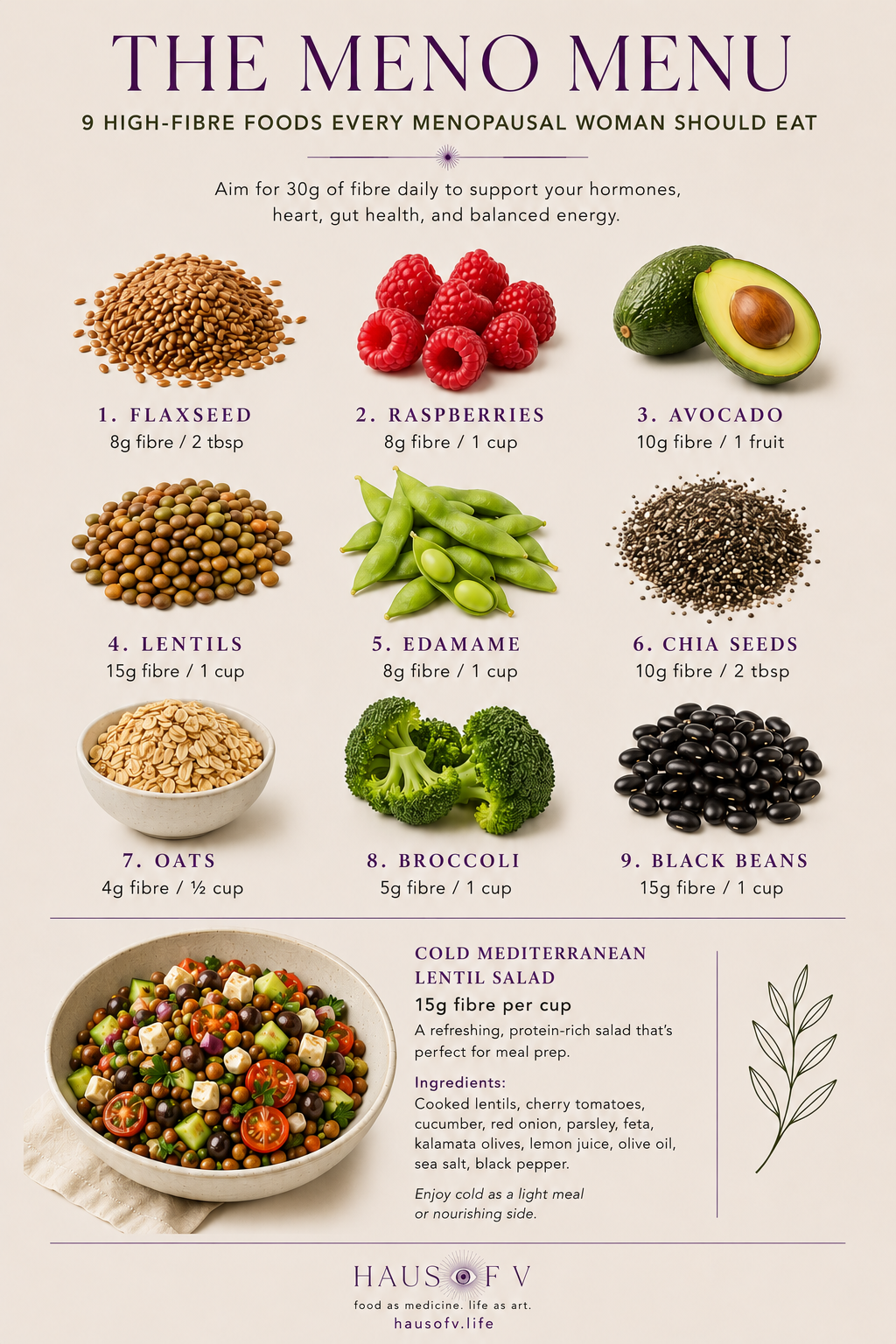
The Meno Menu: 9 fiber-rich foods to keep in rotation
1. Lentils
Lentils are one of the easiest ways to substantially increase fiber while also adding plant protein.
They're incredibly versatile: soups, curries, grain bowls, stews — or the Mediterranean lentil salad we're making below.
2. Raspberries
Berries pack a surprising amount of fiber for their size.
Add raspberries to Greek yogurt, oatmeal or chia pudding, blend them into a smoothie, or simply eat them as a snack.
3. Avocado
Avocado gives you fiber along with unsaturated fats.
Add it to eggs, salads, grain bowls or toast, or turn it into guacamole and eat it with vegetables.
4. Chia seeds
Tiny but mighty.
Chia seeds absorb liquid and form a gel because they're rich in soluble fiber. Stir them into yogurt or overnight oats, add them to smoothies, or make chia pudding.
5. Ground flaxseed
Flax provides fiber along with alpha-linolenic acid, a plant-based omega-3 fatty acid, and naturally occurring lignans.
Try it ground rather than whole. Sprinkle it over oatmeal or yogurt or blend it into a smoothie.
6. Edamame
Edamame gives you the combination we love in midlife: fiber + protein.
Keep frozen edamame around for an easy addition to salads, stir-fries and grain bowls — or simply steam it with a little sea salt.
7. Oats
Oats contain a soluble fiber called beta-glucan, which is particularly well known for its role in supporting healthy cholesterol levels.
Try oatmeal topped with raspberries, chia and ground flax and you've already layered several different fiber sources into one meal.
8. Broccoli
Broccoli provides fiber along with vitamin C, vitamin K, folate and an array of naturally occurring plant compounds.
Roast it until crispy, throw it into a stir-fry, shave it into a salad or add it to soups.
9. Black beans
Beans are an easy way to bring together fiber and plant protein.
Add black beans to salads, tacos, soups and grain bowls, or blend them into dips.
Don't go from zero to fiber hero overnight
This part matters.
If your current diet is relatively low in fiber, suddenly jumping to 30 grams — or beyond — can leave you feeling bloated, gassy and uncomfortable.
Increase your intake gradually and make sure you're drinking enough fluids along the way.
And diversify.
Instead of eating enormous quantities of one “superfood,” rotate among beans, lentils, vegetables, fruit, seeds, nuts and whole grains. Different plants provide different fibers and plant compounds.
A simple question to ask at each meal is:
Where's my fiber?
Breakfast? Add berries, chia, flax or oats.
Lunch? Add lentils, beans, avocado or vegetables.
Snack? Fruit, nuts or edamame.
Dinner? Make vegetables and legumes regular characters rather than occasional guests.
Thirty grams suddenly doesn't seem so intimidating.
Try This: Cold Mediterranean Lentil Salad
This is the kind of recipe we love: simple, colorful, satisfying and easy to make ahead.
It works as lunch on its own, a side dish at dinner or something you can keep in the refrigerator and grab throughout the week.
Ingredients
Optional additions: fresh mint, oregano, chopped bell pepper or a little red wine vinegar.
- 2 cups cooked green, brown, French/Puy or black lentils
- 1 cup cherry tomatoes, halved
- 1 cucumber, chopped
- 1/4–1/2 red onion, finely diced
- 1/3 cup Kalamata olives, sliced
- Large handful fresh parsley, chopped
- 1/3 cup crumbled feta (optional)
- 2 tablespoons extra-virgin olive oil
- Juice of 1 lemon
- Sea salt
- Freshly ground black pepper
If you're starting with dried lentils
For this salad, don't overcook them. You want tender lentils, not mush.
- Rinse. Place the dried lentils in a fine-mesh strainer, check for any small stones or debris, and rinse thoroughly under cool water.
- Skip the soak. Unlike dried beans, lentils don't need to soak overnight. They're ready to cook after rinsing.
- Cook. Place the lentils in a saucepan with plenty of water. Bring to a boil, reduce the heat and gently simmer until tender but still holding their shape — usually about 15–25 minutes, depending on the variety.
- Drain and cool. Drain the cooked lentils well and allow them to cool before assembling your salad.
Using canned lentils?
Even easier.
Canned lentils are already cooked, so simply pour them into a strainer, rinse them very well under cool running water and drain thoroughly.
Then they're ready for the salad.
Put it together
The flavors get even better after they've had a little time to mingle.
- Chop your vegetables. Halve the tomatoes, chop the cucumber and parsley, finely dice the red onion and slice the olives.
- Combine. Add the cooled lentils, tomatoes, cucumber, onion, olives and parsley to a large bowl.
- Dress it. Drizzle with extra-virgin olive oil and fresh lemon juice. Season with sea salt and freshly ground black pepper.
- Add feta — or don't. If you eat dairy, crumble feta over the top. If you prefer it dairy-free, simply leave it out. The salad has plenty of flavor without it.
- Toss and chill. Gently toss everything together and refrigerate before serving if you like it cold.
The bigger picture
Fiber isn't a menopause cure.
It won't balance every hormone, eliminate every symptom or magically change your metabolism.
And that's precisely why it belongs in the conversation.
Good midlife nutrition doesn't have to revolve around powders, protocols or expensive products. Some of the most powerful habits are remarkably ordinary: eat more plants, get enough protein, move your body, build muscle, sleep well and consistently give your body the raw materials it needs.
Aim for around 30 grams of fiber a day. Eat a variety of plants. Keep it simple.
Sometimes supporting your health really can start with raspberries at breakfast and a bowl of lentil salad for lunch.
Welcome to The Meno Menu.
This article is for educational purposes only and is not intended to diagnose, treat or replace individualized medical or nutritional advice.
Written by
Founder, Haus of V
Certified health coach working with women through midlife, hormone health, and longevity. This is educational content, not medical advice.
Keep reading
Get the letter
Twice-monthly essays on hormones, longevity, and food as medicine.